



Your source for fruit and vegetable news
Latest News Blogs/Links Features Classifieds Home. Farmers Markets. Market News. Recipe Corner. About Us. Garden Photos. Archives.

Click for Windsor, Virginia Forecast
By Bobbie Whitehead

One of the first vegetables harvested in North America with archeological findings dating back to 7000-5000 B.C., squash takes center stage this year, becoming the National Garden Bureau Inc. 2010 vegetable of the year.

Each year, the NGB board selects one flower and one vegetable variety to highlight. Squash were “chosen because they are easy to grow from seed, widely adaptable, genetically diverse, and are versatile,” the NGB writes.

In addition, “squash is receiving acclaim for its nutritional value, containing both vitamins and essential minerals.”

Along with featuring squash, the NGB has announced a number of new vegetable varieties for the 2010 season.

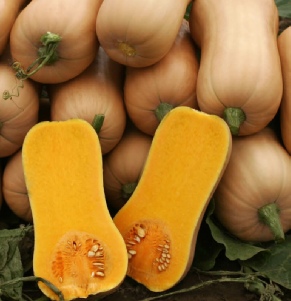
The Squash F1 “Quantum” is one of several new vegetable varieties National Garden Bureau members introduced for 2010 (Photo courtesy of National Garden Bureau Inc.).

National Garden Bureau calls 2010 “Year of the Squash”
One of these varieties includes a new butternut squash called “Quantum.”

Most folks recognize the yellow crookneck or straightneck squash varieties.But the vegetable comes in “more than 20 squash sizes or shapes, ranging in color from blue gray, orange and pink to golden yellow, pastel green, cream and forest green,” according to NGB.

Squash Origins

The Cochise Indians of “what is now the Southwestern United States” were the first to use squash thousands of years ago. In fact, “remains of domesticated squash dating to about 4000 B.C. were found at Bat Cave, New Mexico, along with the remains of pod corn, a primitive ancestor of what we know today as corn,” NGB writes. “This is strong evidence that squash predates corn as a domesticated crop.”

In its in-depth research of squash origins, the NGB found that the planting of squash spread to other American Indian nations after Southwestern tribes migrated to regions in the south and southeast after a 1276 drought occurred and lasted for more than 20 years.

With the Indians’ migration, their farming knowledge, a “polycultural technique” of growing corn, beans and squash together, spread to other tribes, NGB writes.

Squash Types

Most squash is classified as either summer or winter varieties, though a few varieties fall into neither category.

Summer squash varieties include the familiar crookneck/straightneck (yellow), scallop/patty pan (typically white but comes in varieties of other colors), zucchini and vegetable marrow. The winter squash varieties are acorn, banana, buttercup, butternut, Delicata, Delicious and Hubbard. Miscellaneous varieties include the edible gourds, turban and spaghetti squash, according to the NGB.

Growing Squash

For planting, the NGB suggests two different methods. The first is by hilling squash. To begin, growers create a small mound about five inches high with four square feet between mounds. Then, gardeners create an indentation in the top of the mounds, planting several seeds about one-inch deep in each mound. Once plants sprout, the NGB suggests thinning the plants to a few plants per mound.

The second method is row planting with growers creating rows six feet apart to allow plant growth and planting a couple of seeds about one foot apart in the rows. Once plants sprout, the NGB suggests thinning the plants to about one plant every two feet.

Summer and winter squash require a sunny area as well as land that drains well. Also, to aid the growth since squash are considered “heavy feeders,” meaning they use significant amounts of nutrients from the soil, the Virginia Cooperative Extension suggests adding a side dressing of three tablespoons of fertilizer, 33-0-0 or ammonium nitrate, “per 10-foot row” about a week after the plant blossoms appear. Gardeners can repeat this with another side dressing in three weeks, write Diane Relf and Alan McDaniel, Virginia Cooperative Extension extension specialists with Virginia Tech, in their article, “Cucumbers, Melons and Squash.” (To side dress means to place the fertilizer beside the row and work into the soil with a rake.)

Summer squash mature early, ripening about 60 days after planting, and are harvested while still young. Winter squash, however, require a longer growing period – about 80-130 days. Because the winter squash plants grow larger, the NGB suggests providing 12 square feet for each plant and growing on 4-foot high trellises.

Squash F1 “Quantum”

For the new variety Squash F1 “Quantum,” the NGB describes it as having “exceptional uniformity of size and shape” with “a thick neck and a small seed cavity.”

In appearance, the fruit of the Quantum butternut squash, bred by Sakata Seed America Inc. and sold wholesale, grows to 3-5 pounds in weight and “has an attractive smooth tan colored exterior and a bright orange interior,” according to the product description. NGB also describes the Quantum plant, harvested between 100 to 110 days from planting, as having high yields, and the plant has a “strong vigorous vine.”

A few other new vegetable varieties the NGB announced for 2010 include the Bean Pole “Trionfo Violetto,” an Italian heirloom; Lettuce “Skyphos,” a dark-red butterhead lettuce; and Basil F1 “Aristotle,” a Greek basil. For more information about the 15 new vegetable varieties as well as the 40 new flower varieties, visit the National Garden Bureau at http://ngb.org/gardening/varieties/index.cfm.
FREE GAME - Text Twist 2
Your Ad Here