



Your source for fruit and vegetable news
Latest News
Blogs/Links
Features

Classifieds
By Bobbie Whitehead
Gardeners wanting a snack, recipe or salad-type tomato might want to add a new pink cherry tomato called Sweet Treats to their gardens.
Developed by Sakata® Seed Corp., based in Yokohama, Japan, the Sweet Treats stands out as “one of the first pink cherry tomatoes in the world,” according to a company spokesperson.
For those unfamiliar with pink tomatoes, they are genetically different than red tomatoes, said Joey Kitagawa, Sakata® Seed America Inc. marketing coordinator.
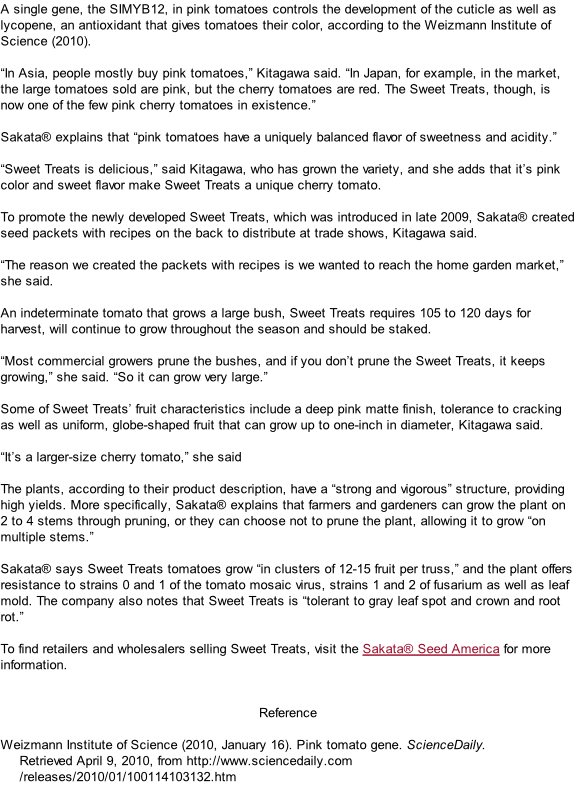
Sweet Treats is a new pink cherry tomato developed by Sakata® Seed Corp. (Photo Courtesy
of the National Garden Bureau).
Sakata® introduces pink cherry tomato, Sweet Treats
A single gene, the SIMYB12, in pink tomatoes controls the development of the cuticle as well as lycopene, an antioxidant that gives tomatoes their color, according to the Weizmann Institute of Science (2010).
“In Asia, people mostly buy pink tomatoes,” Kitagawa said. “In Japan, for example, in the market, the large tomatoes sold are pink, but the cherry tomatoes are red. The Sweet Treats, though, is now one of the few pink cherry tomatoes in existence.”
Sakata® explains that “pink tomatoes have a uniquely balanced flavor of sweetness and acidity.”
“Sweet Treats is delicious,” said Kitagawa, who has grown the variety, and she adds that it’s pink color and sweet flavor make Sweet Treats a unique cherry tomato.
To promote the newly developed Sweet Treats, which was introduced in late 2009, Sakata® created seed packets with recipes on the back to distribute at trade shows, Kitagawa said.
“The reason we created the packets with recipes is we wanted to reach the home garden market,” she said.
An indeterminate tomato that grows a large bush, Sweet Treats requires 105 to 120 days for harvest, will continue to grow throughout the season and should be staked.
“Most commercial growers prune the bushes, and if you don’t prune the Sweet Treats, it keeps growing,” she said. “So it can grow very large.”
Some of Sweet Treats’ fruit characteristics include a deep pink matte finish, tolerance to cracking as well as uniform, globe-shaped fruit that can grow up to one-inch in diameter, Kitagawa said.
“It’s a larger-size cherry tomato,” she said
The plants, according to their product description, have a “strong and vigorous” structure, providing high yields. More specifically, Sakata® explains that farmers and gardeners can grow the plant on 2 to 4 stems through pruning, or they can choose not to prune the plant, allowing it to grow “on multiple stems.”
Sakata® says Sweet Treats tomatoes grow “in clusters of 12-15 fruit per truss,” and the plant offers resistance to strains 0 and 1 of the tomato mosaic virus, strains 1 and 2 of fusarium as well as leaf mold. The company also notes that Sweet Treats is “tolerant to gray leaf spot and crown and root rot.”
To find retailers and wholesalers selling Sweet Treats, visit the Sakata® Seed America for more information.
Reference
Weizmann Institute of Science (2010, January 16). Pink tomato gene. ScienceDaily.
Retrieved April 9, 2010, from http://www.sciencedaily.com
/releases/2010/01/100114103132.htm