


Your source for fruit and vegetable news
Latest News Blogs/Links Features Classifieds Home. Farmers Markets. Market News. Recipe Corner. About Us. Garden Photos. Archives.
Click for Windsor, Virginia Forecast

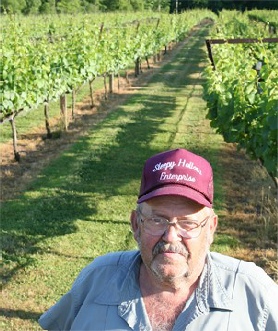
David Lanier of Wakefield, Va., stands in his Sleepy Hollow Vineyard where he grows wine grapes.

Vineyards can thrive in Southeast in spite of challenges
By Bobbie Whitehead

The Southeast Virginia climate may make growing certain grape varieties challenging, but an increasing market for Virginia wines has piqued interest in establishing commercial vineyards here.

Dr. Tony Wolf, professor of viticulture at Virginia Tech, says the market is competitive with Virginia wines taking up a small but growing section of retail shelves.

But with proper care and an understanding of the risks, area growers can make a profit with commercial vineyards, he said.

“Virginia commands only four percent of the market share of all the wines purchased in Virginia, regardless of where the wines come from,” Wolf said. “The first thing the growers need to surmise is there’s a lot of competition out there.”
Wolf, whose unofficially been called the state’s viticulturist, gives presentations across the state to growers and others interested in growing grapes commercially.

“Anywhere in the state, you’re looking at $12,000 to $15,000 an acre to put in a vineyard just to establish it,” Wolf said. “It’s an expensive proposition to get into. Virginia is a tough environment to grow grapes in because the weather is quite variable.”

The temperatures, too, Wolf added, vary from year to year.

“That creates a challenging environment in which to grow grapes,” he said.

One factor that creates a challenge for growers in the Southeastern part of the state is the humidity along with the high summer temperatures, which together can have detrimental effects on the grapes, he said.

“High temperatures are not conducive to the retention of flavor and aromas,” Wolf said. “The frequency of Atlantic storms is another issue. It’s a matter of probability. You have a greater probability of Atlantic storms in the Southeast than the western part of the state.”

Area growers also face the usual diseases growers in other parts of the state face, too, he said.
“There are management tools we can use,” Wolf said. “Grapes are growing in the area, but the management decisions are more intense.”

One grower in Sussex County established a vineyard in 2000 and has had success with the operation, selling his grapes to wineries in Virginia, Maryland, Pennsylvania and North Carolina.

David Lanier operates the Sleepy Hollow Vineyards in Wakefield and said while it takes a few years before the vineyard to begin producing grapes, the enterprise is rewarding.

“You have a few grapes the third year into your operation,” Lanier said. “The fourth year you’ll have a decent crop. But that depends, too, on the weather conditions.”

Lanier, who has farmed all of his life, said Virginia winemakers are getting a larger percentage of the market now.

“Virginia wines are becoming more noticeable,” said Lanier, who has seven acres of the Chardonnay and Merlot varieties of grapes.

With careful management and cutting back his vines each year at the top of the trellis system used, Lanier said his vineyard does well. Lanier's vineyards use an open lyre trellis system that resembles a small football goal post to keep the vines growing upward. To separate the vines, the open lyre system divides the canopy, giving better sunlight on the vines and thus increasing the grape yields, Lanier said.

“It’s a lot of hand work involved all year, and it’s very labor-intensive, time consuming, and very expensive to start out,” Lanier said. “But it’s very rewarding; to me, it is, to look back and see what you’ve accomplished.”

During a May tour of Lanier's vineyard after the first area vineyard school, about five growers from Surry County expressed a serious interest in developing a commercial vineyard, said Glenn Slade, Surry agricultural extension agent.

"Several have inquired about the start-up costs," Slade said. "Some growers like Dave Shelton are adding a few acres each year, putting in the vineyard in stages to defer the cost."

Southeastern Virginia has a small number of vineyards with some growing for the Williamsburg winery, said Janet Spencer, area extension agent for commercial vegetables for the Tidewater Agricultural Research and Extension Center in Suffolk.

“The Virginia wines are actually growing in popularity," Spencer said. "Some of the larger grocery chains have a specific section for Virginia wines.”

Virginia requires wineries to have a certain number of their grapes grown in the state in order for the wineries to call their wines a “Virginia wine.” For this reason, Spencer said, there’s been an interest in increasing the vineyards here.
Your Ad Here