




Your source for fruit and vegetable news
Latest News Blogs/Links Features Classifieds Home. Farmers Markets. Market News. Recipe Corner. About Us. Garden Photos. Archives.
Click for Windsor, Virginia Forecast

Entomologist says 2008’s a better year for honeybees
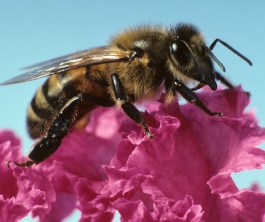
In general, honey bee health has been declining since the 1980s, with the introduction of new pathogens and pests (Photo by Rob Flynn, U.S. Department of Agriculture Agriculture Photo Center).
By Bobbie Whitehead

With bee populations declining worldwide, Virginia bee colonies, at least, have experienced some growth so far this year.

“This has been a good year for bees,” said Dr. Rick Fell, Virginia Tech professor of entomology. “This year we had good conditions in the spring, and there’s growth this year, which is good since we’ve had tremendous losses of honey bees in the last 20 years.”

With a significant loss of honey bees in 2006 and last year, researchers termed the loss colony collapse disorder and have been trying to identify what may be causing the decline in honey bee colonies.
Bee losses, especially during the winter, occur naturally, but in 2007, Fell said beekeepers lost more than 50 percent of their colonies.

Researchers have found several problems honey bees are experiencing, one being a problem with mites, and researchers have also identified the Israel Acute Paralysis Virus, too, which has caused problems, Fell said. However, researchers have not identified a single cause for the colony collapse disorder, he said.

Although bees have succumbed to some viruses and pests, miticides used to control bee mites have affected the bees, and the lack of information the public has about bees, too, can result in losses, Fell said.

“People have a tendency to fear bees,” Fell said. “What we’re concerned with is the protection of the bee pollinators. Bees are out there collecting pollen, and they’re not going to be aggressive. But swatting is an action that can lead to bad encounters with bees.”

People need more knowledge about bees’ contributions to benefiting their gardens, farmers’ crops, honey creation and the environment, Fell said.

To avoid harming bees, Fell suggests that people make sure they know the particular insect before destroying it – is it a bee or a wasp. Sometimes people are unsure because of the numerous bee varieties and believe they may be killing a yellow jacket or a wasp, he said.

Wasps, too, are good predators of pests, and before destroying what appears to be a nest of wasps or bees, Fell said residents should determine if the bees or wasps are located in an area that might cause harm to people. If not, Fell said it’s best to leave them alone.

“Bees’ value for pollination is greater than the amount of honey they create,” he said.

Another way to avoid encounters with honey bees is to avoid wearing perfumes or scented deodorants, hairspray, or lotions when working outdoors because the bees will follow the scent, thinking it is a flower.

Bees usually search for nectar during the middle of the day. Because of this, the U.S. Department of Agriculture said residents should avoid spraying pesticides during that time to avoid harming the bees. To encourage the growth of bee populations, the USDA said residents can plant bee balm, red clover or foxglove, which will provide nectar for bees.

Glenn Slade, Surry County agricultural extension agent, said if residents in the area have swarms of bees they fear or don’t want, avoid killing them or spraying pesticides. Instead, residents should contact their local extension service for a listing of people in the area who will come to their residences to remove the bees.

“Bees pollinate a lot of plants, and they don’t sting too often unless someone agitates them,” Slade said.

One local beekeeper who will remove a swarm of bees for free or at the least help residents figure out how to eliminate a problem is Sean Kenny of Suffolk. Kenny can be reached by calling 255-0989 or 560-3788, or to ask a question, e-mail Kenny at s.p.kenny@charter.net.
FREE GAME - Text Twist 2
Your Ad Here