



Your source for fruit and vegetable news
Latest News Blogs/Links Features Classifieds Home. Farmers Markets. Market News. Recipe Corner. About Us. Garden Photos. Archives.

Click for Windsor, Virginia Forecast
By Bobbie Whitehead

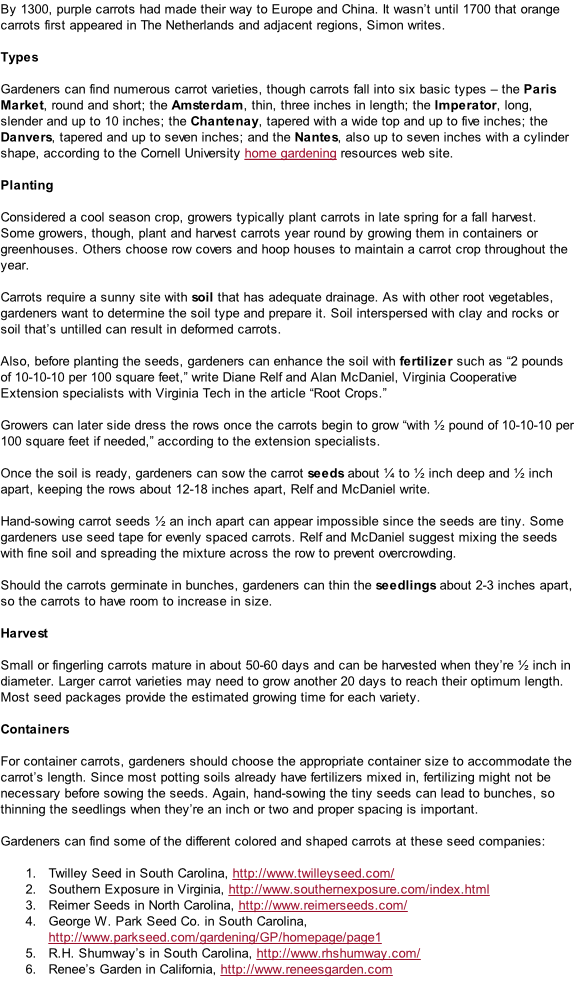
Gardeners can opt for a color other than orange when planting carrots. The root vegetable comes in a variety of colors as well as different shapes and sizes – long or short, cone or cylinder-shaped as well as round and slightly larger than a quarter.

Originating in Afghanistan, the first domestic carrots, purple and yellow, moved from the Middle East to the Mediterranean area between 900-1000 A.D., writes P.W. Simon, U.S. Agricultural Research Service geneticist with the University of Wisconsin-Madison, in the article “Carrot Facts.”

Carrots come in a variety of colors and shapes (Photo Source: U.S.  Agricultural Research Service).

Gardeners, add some carrots in different shapes, colors
By 1300, purple carrots had made their way to Europe and China. It wasn’t until 1700 that orange carrots first appeared in The Netherlands and adjacent regions, Simon writes.

Types

Gardeners can find numerous carrot varieties, though carrots fall into six basic types – the Paris Market, round and short; the Amsterdam, thin, three inches in length; the Imperator, long, slender and up to 10 inches; the Chantenay, tapered with a wide top and up to five inches; the Danvers, tapered and up to seven inches; and the Nantes, also up to seven inches with a cylinder shape, according to the Cornell University home gardening resources web site.

Planting

Considered a cool season crop, growers typically plant carrots in late spring for a fall harvest. Some growers, though, plant and harvest carrots year round by growing them in containers or greenhouses. Others choose row covers and hoop houses to maintain a carrot crop throughout the year.

Carrots require a sunny site with soil that has adequate drainage. As with other root vegetables, gardeners want to determine the soil type and prepare it. Soil interspersed with clay and rocks or soil that’s untilled can result in deformed carrots.

Also, before planting the seeds, gardeners can enhance the soil with fertilizer such as “2 pounds of 10-10-10 per 100 square feet,” write Diane Relf and Alan McDaniel, Virginia Cooperative Extension specialists with Virginia Tech in the article “Root Crops.”

Growers can later side dress the rows once the carrots begin to grow “with ½ pound of 10-10-10 per 100 square feet if needed,” according to the extension specialists.

Once the soil is ready, gardeners can sow the carrot seeds about ¼ to ½ inch deep and ½ inch apart, keeping the rows about 12-18 inches apart, Relf and McDaniel write.

Hand-sowing carrot seeds ½ an inch apart can appear impossible since the seeds are tiny. Some gardeners use seed tape for evenly spaced carrots. Relf and McDaniel suggest mixing the seeds with fine soil and spreading the mixture across the row to prevent overcrowding.

Should the carrots germinate in bunches, gardeners can thin the seedlings about 2-3 inches apart, so the carrots to have room to increase in size.

Harvest

Small or fingerling carrots mature in about 50-60 days and can be harvested when they’re ½ inch in diameter. Larger carrot varieties may need to grow another 20 days to reach their optimum length. Most seed packages provide the estimated growing time for each variety.

Containers

For container carrots, gardeners should choose the appropriate container size to accommodate the carrot’s length. Since most potting soils already have fertilizers mixed in, fertilizing might not be necessary before sowing the seeds. Again, hand-sowing the tiny seeds can lead to bunches, so thinning the seedlings when they’re an inch or two and proper spacing is important.

Gardeners can find some of the different colored and shaped carrots at these seed companies:

1.
Twilley Seed in South Carolina, http://www.twilleyseed.com/
2.
Southern Exposure in Virginia, http://www.southernexposure.com/index.html
3.
Reimer Seeds in North Carolina, http://www.reimerseeds.com/
4.
George W. Park Seed Co. in South Carolina, http://www.parkseed.com/gardening/GP/homepage/page1
5.
R.H. Shumway’s in South Carolina, http://www.rhshumway.com/
6.
Renee’s Garden in California, http://www.reneesgarden.com
FREE GAME - Text Twist 2
Your Ad Here